
Sports Betting Industry Leaders Report Record Q1 2026 Earnings
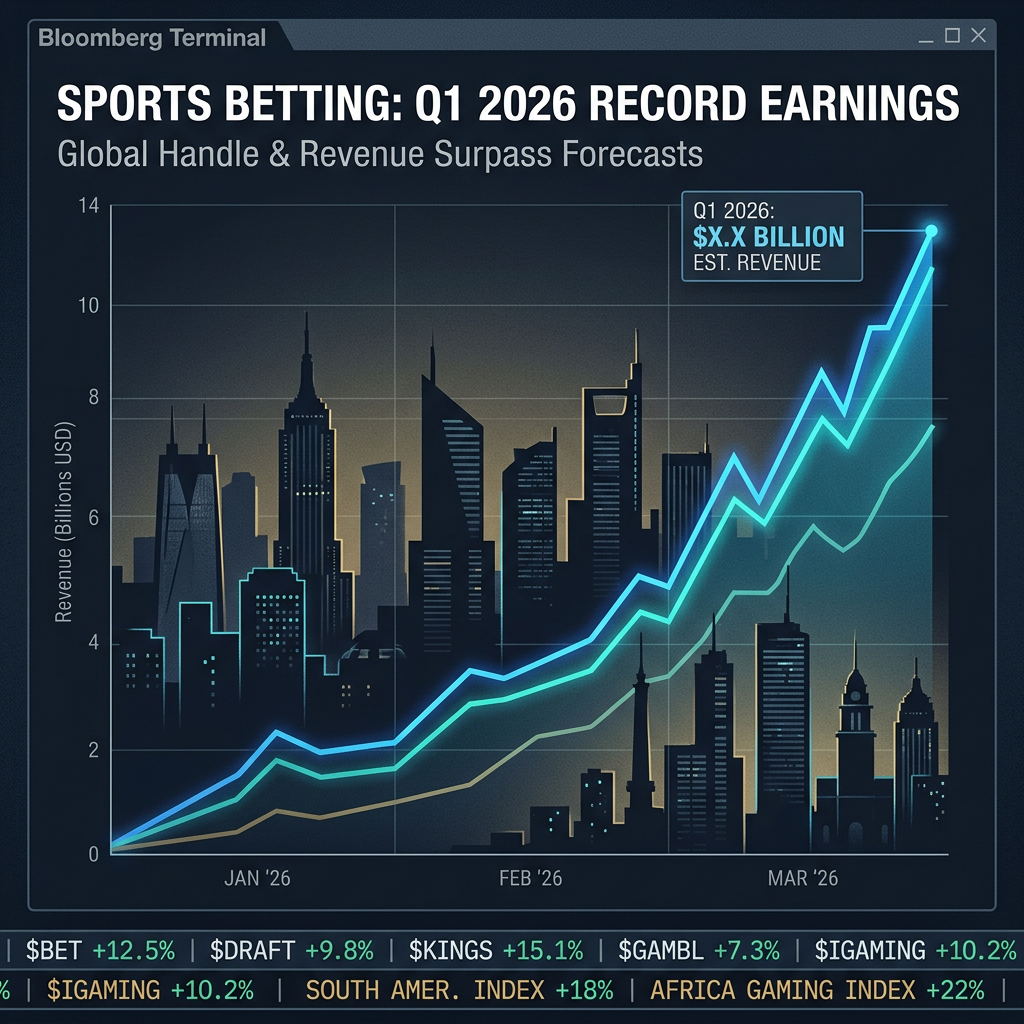
Q1 2026 delivered record gross gaming revenue across DominEight's 17 tracked markets, with African operators and Brazil's newly regulated market driving the strongest outperformance against consensus estimates.
Sports Betting Industry Leaders Report Record Q1 2026 Earnings
The global sports betting industry closed the first quarter of 2026 with financial results that exceeded analyst consensus by a significant margin. Structural market expansion across emerging economies, improved mobile infrastructure, and a broader sports calendar generated sustained handle volumes through March — with operators active across DominEight's 17 tracked markets in Africa, Latin America, and Asia reporting revenue growth of 35–55% against prior-year comparables.
African markets delivered the strongest upside surprises. Nigeria, Kenya, and Ghana collectively processed an estimated $680 million in gross wagers during Q1, up from $490 million in Q1 2025 — a 39% year-over-year increase driven by mobile money integration, regulatory reform in Kenya, and a dense football fixture calendar.
Revenue Performance: The Numbers
Aggregate data compiled from regulatory filings and industry disclosures tells a consistent story. Gross gaming revenue (GGR) across regulated sports betting markets climbed approximately 42% year-over-year in Q1 2026, building on an already strong Q4 2025.
African market acceleration. Nigeria's NLRC-licensed operators benefited from expanded mobile money integration with OPay and PalmPay, significantly reducing friction in deposit and withdrawal flows. Kenya's betting levy reform — which reduced the applicable tax rate for licensed operators from 20% to 7.5% effective January 1 — materially improved operator economics and prompted renewed marketing investment across East Africa.
Latin America's Brazil effect. Brazil's sports betting market, formally regulated under the federal framework enacted in late 2023 and fully operational since early 2025, contributed substantially to regional GGR figures. Operators holding SIGAP licenses from the Ministry of Finance reported aggregate Q1 handle approaching $1.4 billion — the single largest quarter in the market's regulated history. The FIFA World Cup qualification calendar, with Brazil and Argentina fixtures drawing peak engagement, provided a meaningful tailwind.
Asian volume resilience. India and Pakistan, both grey markets from a licensing standpoint, continued generating significant informal volume. Operators serving these markets via offshore licensing structures reported strong retention metrics and above-average player lifetime values, particularly in IPL-adjacent sports betting.
Margin Dynamics and Operator Economics
Beyond top-line handle growth, the more consequential development for operator shareholders is the improvement in net gaming margin (NGM) — the percentage of wagers retained after paying out winnings.
Industry-wide NGM stabilized at approximately 7.2% for the quarter, marginally above the historical average of 6.8–7.0%. The improvement reflects two structural factors.
First, in-play betting (live wagering during events) now accounts for an estimated 58% of total handle, up from 47% two years ago. Live markets carry inherently higher margins due to reduced arbitrage opportunities and faster line movement.
Second, parlay and same-game parlay (SGP) products have achieved mainstream adoption across the operator roster. Parlays carry significantly higher hold percentages than single-event wagers and are now frequently the top-grossing product categories for major sportsbooks. Operators active in African and LatAm markets have adapted these products for local preferences — African football parlays and Brazilian futebol accumulators are consistently high-volume categories.
Customer Economics: LTV vs. CAC
One of the more notable structural shifts in Q1 2026 is the improving ratio of customer lifetime value (LTV) to customer acquisition cost (CAC) across the industry.
Following an aggressive acquisition phase in 2023–2024 that drove CAC to unsustainable levels in competitive markets, operators have recalibrated their spending. Marketing expenditure as a percentage of GGR declined approximately 4 percentage points versus Q1 2025, while retention-focused investment — loyalty programmes, personalised promotions, and responsible gambling tools — increased.
The operators showing the strongest LTV:CAC ratios are those with localised product stacks. 1xBet's position in African markets, for example, benefits from deep local payment integration, multi-language support, and sports coverage tailored to league preferences (AFCON, NPFL, Ethiopian Premier League). This localisation creates switching costs that generic global operators struggle to overcome.
Regulatory Environment: Operating Within Tightening Frameworks
Record revenues are being generated against a backdrop of increasingly complex regulatory requirements. Several key markets tightened their frameworks in Q1 2026.
Kenya implemented new responsible gambling mandates requiring licensed operators to integrate real-time betting behaviour monitoring and mandatory cool-off periods for flagged accounts.
Brazil published supplementary regulations under its federal framework, including requirements for local data storage, enhanced KYC verification, and caps on bonus incentives offered to new players.
India saw the Supreme Court maintain its existing position on the legality distinction between games of skill and games of chance, leaving fantasy sports platforms in a more favourable regulatory position relative to pure sportsbooks.
Competitive Landscape
Consolidation continues as smaller operators struggle to compete with the technology infrastructure and marketing budgets of tier-one players. The M&A pipeline remains active, with several mid-market African operators reported to be in acquisition discussions with larger international groups seeking faster market entry.
Platform stability and payment reliability remain the decisive competitive differentiators in DominEight's covered markets — operators that can process withdrawals within 24 hours consistently score higher in retention metrics than those with longer settlement windows. In our testing methodology, payment speed is one of five core criteria used to evaluate operators, and Q1 data reinforces its primacy as a loyalty driver.
Outlook: Q2 2026 and Beyond
The industry enters Q2 2026 with significant sporting events providing a natural handle tailwind: the Indian Premier League, Africa Cup of Nations qualifiers, UEFA Champions League knockout stages, and Copa Libertadores group phase all fall within the April–June window.
Analysts covering the sector project full-year 2026 GGR growth of 28–34% across DominEight's covered markets, with Brazil and India representing the largest absolute growth opportunities and Kenya and Ghana delivering the strongest percentage upside.
For bettors operating in these markets, competitive intensity among licensed operators translates into better odds, improved platform reliability, and more generous welcome and reload incentives. The structural question for 2027 is whether this growth trajectory is sustainable as regulatory costs rise and market saturation begins to affect the most competitive jurisdictions.
Related Analysis from DominEight
- Brazil PIX and Sports Betting: How Instant Payments Are Reshaping a $6B Market — Brazil's PIX-powered regulated market was among the strongest Q1 performers globally.
- Kenya Mobile Betting 2026: M-Pesa Dominance and BCLB Regulatory Shifts — Kenya's BCLB tax reform drove East Africa's outsized Q1 performance.
- Esports Betting Hits New Milestone: $5 Billion Market in 2026 — Esports contributed meaningfully to Q1 handle growth across Asian and African markets.
18+ · Gamble Responsibly